
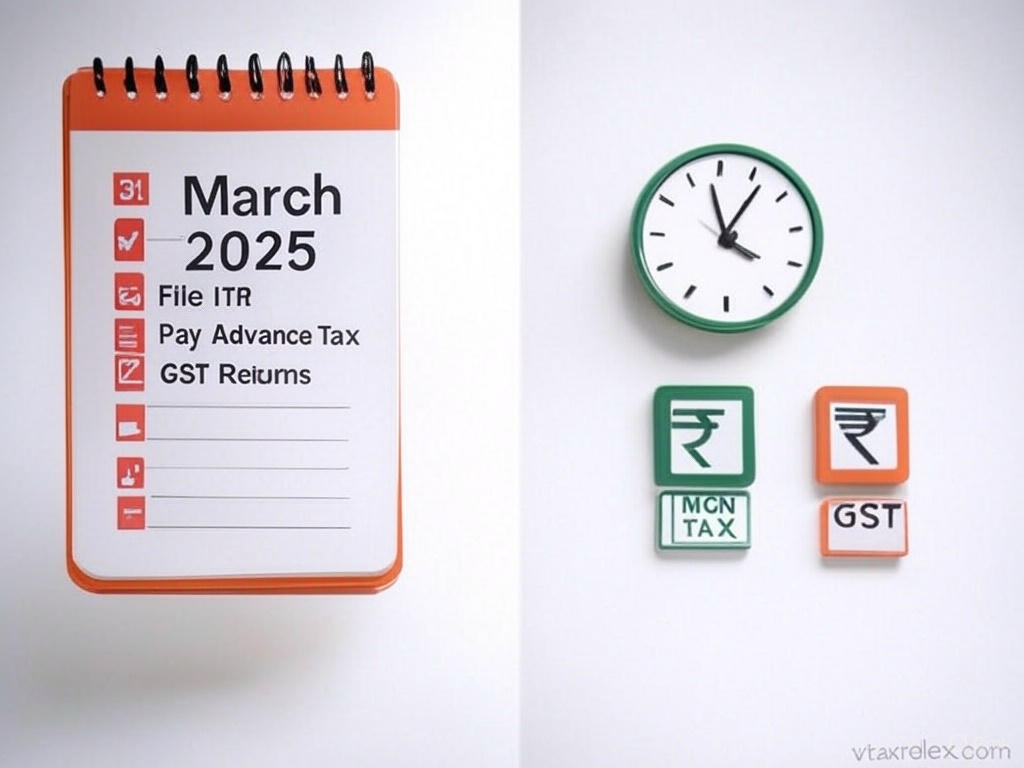
31 March: The Last Chance to Check Your To-Do List for Income Tax and GST Compliance in India
As the financial year in India draws to a close on March 31, 2025, taxpayers across the country are racing against time to ensure they meet critical deadlines for Income Tax and Goods and Services Tax (GST) compliance. Missing these deadlines can lead to penalties, interest charges, and missed opportunities for tax savings. Whether you’re an individual taxpayer, a small business owner, or a large corporation, March 31 marks the final chance to tick off essential tasks on your tax to-do list. In this detailed guide, we’ll walk you through the key Income Tax and GST tasks you need to complete before the deadline, helping you stay compliant and stress-free. For personalized assistance, tools, and expert guidance, visit vtaxrelax.com to simplify your tax journey.
Why March 31 Is a Crucial Deadline for Taxpayers in India
The financial year in India runs from April 1 to March 31, and this period is pivotal for both Income Tax and GST compliance. March 31, 2025, is the last day of the Financial Year (FY) 2024-25, meaning it’s your final opportunity to take actions that can impact your tax liability for the year. From making tax-saving investments to filing pending GST returns, the decisions you make by this date can save you from penalties and help you optimize your tax obligations. Let’s break down the essential to-do list for both Income Tax and GST, ensuring you’re fully prepared as the deadline approaches.
Income Tax To-Do List Before March 31, 2025
Income Tax compliance involves several tasks that must be completed by the end of the financial year to avoid penalties and maximize savings. Here’s what you need to focus on:
1. Make Tax-Saving Investments (Old Regime)
If you’ve opted for the old tax regime for FY 2024-25, March 31 is your last chance to make tax-saving investments and claim deductions. The old regime allows deductions under various sections of the Income Tax Act, such as:
Section 80C: Invest up to ₹1.5 lakhs in options like Public Provident Fund (PPF), Equity-Linked Savings Scheme (ELSS), National Savings Certificate (NSC), or life insurance premiums. This can save you up to ₹46,800 in taxes (at the 30% slab, including cess).
Section 80D: Purchase health insurance for yourself, your family, or senior citizen parents. You can claim up to ₹25,000 for self/family and ₹50,000 for senior citizen parents, saving up to ₹23,400 in taxes.
Section 80CCD(1B): Contribute an additional ₹50,000 to the National Pension Scheme (NPS) over the 80C limit, saving an extra ₹15,600.
Action Tip: If you haven’t invested yet, calculate your potential savings with expert available at vtaxrelax.com and make these investments before the deadline.
2. Pay Advance Tax (Final Installment)
If your tax liability for FY 2024-25 exceeds ₹10,000, you’re required to pay advance tax in installments throughout the year. The final installment for FY 2024-25 is due on March 15, 2025, but if you’ve missed it, you can still pay by March 31 to minimize interest penalties under Sections 234B and 234C. Interest is charged at 1% per month for late payments, so acting quickly is crucial.
Example: If your total tax liability is ₹2 lakhs, you should have paid 100% of it by March end
(in installments: 15% by June 15, 45% by September 15, 75% by December 15, and 100% by March 15). If you’ve only paid ₹1.5 lakhs, pay the remaining ₹50,000 by March 31 to reduce interest charges.
Action Tip: Visit vtaxrelax.com to consult on your estimated liability and make payments online.
3. File Updated Income Tax Returns (ITR-U)
March 31, 2025, is the last date to file an Updated Income Tax Return (ITR-U) for FY 2021-22 (AY 2022-23). The government recently extended the window for filing ITR-U from 2 years to 4 years from the end of the relevant assessment year, giving taxpayers more time to correct errors or disclose additional income. However, filing ITR-U comes with an additional tax:
– Within 12 months: 25% of tax and interest due.
– Within 24 months: 50% of tax and interest due.
– Within 36 months: 60% of tax and interest due.
– Within 48 months: 70% of tax and interest due.
If you missed reporting income or made an error in your FY 2021-22 return, file ITR-U with expert advise to avoid further penalties.
4. Link PAN with Aadhaar
The Income Tax Department has repeatedly emphasized the importance of linking your Permanent Account Number (PAN) with Aadhaar. While the deadline for this was extended multiple times in the past, failing to link by March 31, 2025, can render your PAN inoperative, leading to issues with tax filings, refunds, and TDS deductions.
5. Invest in Government Schemes
Schemes like the Pradhan Mantri Vaya Vandana Yojana (PMVVY), a pension scheme for senior citizens, require investments by March 31, 2025, to be eligible for FY 2024-25 benefits. You can invest up to ₹15 lakhs, securing a steady income while also claiming tax benefits under the old regime.
GST To-Do List Before March 31, 2025
GST compliance is equally critical, especially for businesses, as March 31 marks the end of several key deadlines. Here’s what you need to prioritize:
1. File Pending GST Returns
March 31, 2025, is the last date to file certain GST returns and forms for FY 2024-25 or earlier years, depending on notifications. Key forms include:
GSTR-1 and GSTR-3B: If you’ve missed filing monthly or quarterly returns, file them by March 31 to avoid late fees (₹50 per day for taxable returns, ₹20 per day for nil returns) and interest at 18% per annum.
GSTR-9 and GSTR-9C: The annual return (GSTR-9) and reconciliation statement (GSTR-9C, for businesses with turnover above ₹5 crore) for FY 2023-24 were due by December 31, 2024. However, if you missed this, check for any extensions and file immediately to minimize penalties.
CMP-02: If you wish to opt into the GST composition scheme for FY 2025-26, file CMP-02 by March 31, 2025.
Consult with vtaxrelax.com to check your pending returns and file them seamlessly.
2. Apply for Letter of Undertaking (LUT) for Exports
If you’re an exporter, you must file Form RFD-11 (Letter of Undertaking) by March 31, 2025, to export goods or services without paying GST for FY 2025-26. Missing this deadline means you’ll need to pay GST upfront and claim a refund later, impacting your cash flow.
3. Reconcile Input Tax Credit (ITC)
March 31 is a good time to reconcile your Input Tax Credit (ITC) for FY 2024-25. Ensure that the ITC claimed in your GSTR-3B matches the details in GSTR-2A/2B. Discrepancies can lead to notices from the GST department. Additionally, if you’ve opted for the composition scheme for FY 2025-26, reverse any ITC pertaining to previous years by March 31.
4. Pay Central Excise Duty (If Applicable)
For businesses liable to pay Central Excise Duty, March 31, 2025, is the due date for payments related to March 2025 transactions. This applies to specific sectors like petroleum, as noted in recent advisories by the Central Board of Indirect Taxes and Customs (CBIC).
5. Revoke Cancelled GST Registration
If your GST registration was cancelled and the last date to apply for revocation falls before March 31, 2025, ensure you file the application by this date. For instance, taxpayers have been given extended windows in the past to revoke cancellations, often up to March 31 of the following year.
Consequences of Missing the March 31 Deadline
Failing to complete these tasks by March 31, 2025, can lead to significant repercussions:
Penalties and Interest: Late filing of ITR or GST returns attracts penalties (e.g., ₹5,000 for ITR, ₹50 per day for GSTR-1) and interest (1% per month for Income Tax, 18% per annum for GST).
Loss of Deductions: Missing tax-saving investments means you can’t claim deductions for FY 2024-25.
Operational Issues: An inoperative PAN or delayed GST filings can disrupt refunds, TDS credits, and business operations.
Legal Notices: Non-compliance may lead to scrutiny, notices, or even prosecution in severe cases of tax evasion.
How to Stay on Top of Your Tax To-Do List
With so many deadlines converging on March 31, staying organized is key. Here are some tips:
1. Create a Checklist: List all Income Tax and GST tasks specific to your situation.
2. Leverage Technology: Use online platforms to automate calculations and filings.
3. Seek Expert Help: If you’re unsure about any task, consult a tax professional. You may visit vtaxrelax.com to consult with us on your issues for a free advice for a seamless experience on filing support, and reminders to ensure you never miss a deadline.
FAQs About March 31 Tax Deadlines
1. What happens if I miss the March 31 deadline for tax-saving investments?
You’ll lose the chance to claim deductions for FY 2024-25, increasing your tax liability.
2. Can I file GST returns after March 31?
Yes, but you’ll incur late fees and interest. File as soon as possible to minimize penalties.
3. How do I know if I need to pay advance tax?
If your tax liability exceeds ₹10,000 for the year, advance tax is mandatory. Check using vtaxrelax.com’s calculator.
4. What if my PAN isn’t linked to Aadhaar by March 31?
Your PAN may become inoperative, affecting tax filings and refunds.
Act Now to Stay Compliant
March 31, 2025, is your last chance to complete critical Income Tax and GST tasks for FY 2024-25. From making tax-saving investments to filing pending returns, every action you take before the deadline can save you money and stress. Don’t let penalties or missed opportunities weigh you down—take control of your tax obligations today.
For a hassle-free experience, visit vtaxrelax.com to access filing support, and expert advice tailored to your needs.
Stay compliant, save more, and relax with vtaxrelax.com by your side!